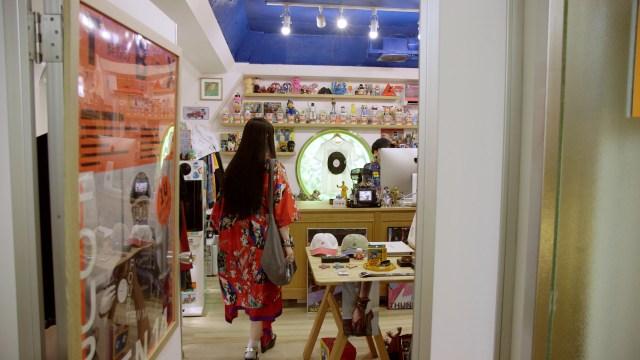
The latest instalment of Toco Toco features KAE, a Tokyo-based accessory designer and founder of fashion brand High-Me, showcasing her retro-inspired acrylic work. At a glance, it may seem bizarre to see something like this crop up on a games culture-focused site. However, I thought it was more than worthy of sharing, both as a continuing fan of Toco Toco’s content, as well as thanks to the close look it offers at Nazo no mise, the flagship store of design label THUNDERBOX which, despite being quietly tucked away on the third floor of a Nakano building, doubles as a treasure trove of 80s and 90s nostalgia.
Amidst a wide selection of clothing items, which have previously included bespoke, one-off pieces, the walls and shelves of Nazo no mise are adorned with an impressive collection of authentic vintage items from all areas of 80s and 90s pop culture, both Japanese and with some western touches here and there. You might think this sounds cliche, but a well-selected assortment of goods combined with a unique fashion style work together to create a brilliant-looking aesthetic that you should check out for yourself – in the video linked above, or over on the shop’s Instagram page.
You can have a browse of Toco Toco’s library of fascinating Japanese culture videos on their official YouTube channel and get regular updates about new videos on Twitter. Nazo no mise can also be found on Twitter, as well as on the THUNDERBOX website which features an online store – see if any of their threads take your fancy.
Despite a relatively quiet September here on Minus World, our fifth reading list this year is our busiest yet. In no particular order, we’ve got another selection of must-see articles and videos that are definitely worth your attention.
First up, Mathew Kumar of Every Game I’ve Finished and exp. zine fame was featured on Tiny Cartridge towards the end of the month, with a unique perspective on a game held in something similar to notoriety amongst fans of Nintendo’s 3DS eShop. A significant quantity of titles offered as ‘Volumes’, as well as a divisive level of quantity – one which has a tendency to lean towards ‘poor’ amongst popular opinion – has allowed the Japanese Rail Sim 3D series to stand out amongst other downloadable 3DS offerings for more than just its pricing. Kumar takes a look at the Journey to Kyoto instalment in particular, able to offer some insight into the game beyond its reputation having actually taken the featured train line himself. It’s not every day a title as niche as this will allow you to simulate an experience from your own life, so Kumar’s personal take on what the game has to offer, as well as the quality of the title itself, certainly make for an interesting read.
Continuing the theme of personal experiences, it is often anecdotes that make for the most interesting gaming-related reads. Rebekah Saltsman, indie dev and CEO of two-person studio Finji, offered a particularly relatable one in an article for The Guardian, which eloquently touches on feelings of youth, escapism and that age-old struggle against older siblings for a turn that games continue to provide. The distinct focus on role-playing games, especially those on the SNES, is one that many who grew up with Nintendo’s 16-bit system in their household will have no trouble associating with.
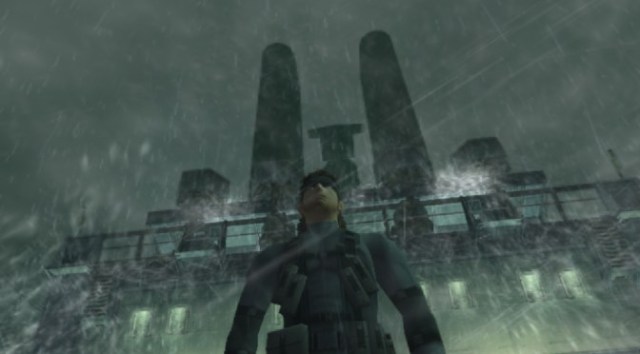
Jeffrey L. Wilson offered a touching anecdote of his own that many will be sure to relate with, but in a completely different manner to the aforementioned examples. Wilson’s very personal story about how Metal Gear Solid 2: Sons of Liberty helped him to cope in the aftermath of 9/11 not only reflects on the chilling synchronicity between the events of the game and those that took place in 2001, but the way in which the game’s alternate take on reality offered a sense of comfort amidst a troubling time. It’s difficult to summarise an article invested with such great personal meaning, so be sure to read it for yourself.
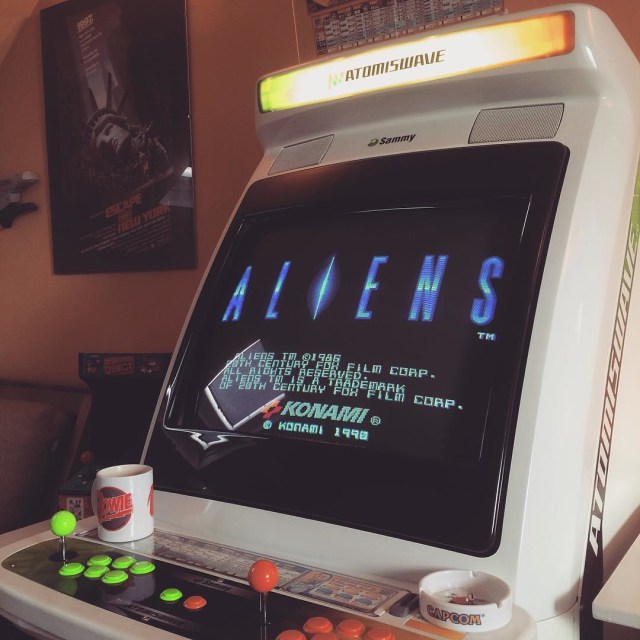
We’ve previously taken a look at the work of Stuart Brett (formerly known by the moniker SuperFamicomGuy), namely his book release from earlier this year, Super Famicom: The Box Art Collection. Following a successful release that compiled the best box artwork from his impressive Super Famicom collection, Brett has now turned his attention to arcade games, the focus of his new project titled Ghost Arcade. Showcasing some of the finest games that arcade hardware has to offer, as well as the culture and nostalgia surrounding them, Ghost Arcade features write-ups and interviews presented in a classy format. One particular article that caught our attention was a look at Cannon Dancer Osman, something of a spiritual successor to Strider created by ex-Capcom designer Kouichi ‘Isuke’ Yotsui. A unique beat-’em-up with gorgeous presentation, Brett does well to showcase the highs and lows of Osman with short video clips that capture a bizarrely haunting authentic arcade feel. You’d be wise to follow Brett on Instagram, where he posts some awe-inspiring shots of select pieces from his collection.
Now for something that’s simply bizarre. It’s no secret that Hidetaka ‘Swery’ Suehiro is a purveyor of the unexpected, with unique games such as Deadly Premonition and D4 touching on surreal motifs that have quickly garnered a strong cult following. Swery’s latest escapade is perhaps his most curious to date, however, and it has nothing to do with games – he has become a fully certified Buddhist priest. As discussed in an interview with IGN, Swery grew up in a Buddhist temple, something he believes has fuelled his desire to give a ‘human’ quality to his games, and during a period of recovery from illness in which he has stepped away from game development, this has offered him a chance to return to his spiritual roots. It’s interesting to hear more about the origins of one of gaming’s most ambitious figures, something which we have touched on previously when we covered his appearance on Toco Toco – with this video in mind, it remains to be seen if Swery’s new role will accommodate his love of what he refers to as ‘drinKING‘…
Level design is one of the most significant aspects of the game design process – its impact on a game extends beyond simply the look and feel of the environment. However, its importance is often overlooked when considered alongside other game mechanics. As you work on how your characters will jump, shoot and run through the environment it’s important that the motions of the characters feel natural in relation to the locations they are placed in. This is where level design can greatly help a game to stand out. A good layout can enhance the overall experience of your players, while a poor layout can feel tedious or even obstructive when moving forward. The structure of each level is critical to any game’s overall design.
The key issue with level design is that it is both subjective and relative to the style of game. Some would argue that straight paths and linear corridors make for bad levels, but consider your experience when playing an arcade beat-em-up such as Double Dragon. Within the context of that particular title and genre, linear stages are incredibly helpful in asserting the game’s progression and pacing. It all depends on what is the most organic way of achieving a sense of flow of progression.
Anyone who has played a Sonic the Hedgehog game can attest to the frustrations of speeding through a level – something the game claims to champion – only to lose momentum or hit a dead end and then have to backtrack in order to progress. As you design levels for any type of game, you’ll want to keep in mind where the players can go and what potential road blocks they will encounter. It’s not a bad thing to implement boundaries or to keep players on track – at the same time your game doesn’t need to be completely open either. If you find that there are going to be dead ends or complete halts to progression in your game, you can still make these areas interesting by occupying them with an interactive element such as a power-up item or collectible. By using this approach, when a player encounters a stop in momentum they will still feel like they are making progress by finding something, even if they have to do a little backtracking to get back on course.
Phoenix Wright can’t catch a break. Not unlike a Japanese-made, courtroom-dwelling version of Murder, She Wrote‘s Jessica Fletcher, Capcom’s big-voiced comeback king attorney is seemingly followed by trouble, normally of the legal kind, wherever he goes (the two also appear to share a fondness for outlandishly big hair). This is no different in his sixth mainline outing, Phoenix Wright: Ace Attorney – Spirit of Justice, which takes the series’s trademark courtroom drama to an exotic new location, which presents our justice-seeking hero with more challenges than you might initially think.
Set primarily in the fictional Himalayan monarchy of Khura’in, in which magic stands as court precedent and lawyers have been done away with in favour of seance rituals that project the final moments of the deceased, it’s clear that Wright is, once again, completely out of his depth. Whilst it’s not hard to feel sympathy for the guy every time, it’s a relief to find that the judicial misadventures of the Ace Attorney series have once again shaped themselves into an engrossing and well-structured visual novel that puts a theatrical spin on the otherwise mundane.
It is the aforementioned magical seances that provide the biggest shake-up in the courtroom this time around. Perhaps more ground-breaking narratively than from a gameplay perspective, the process of witnessing that crucial instance seconds before a victim’s passing introduces a new wildcard element to your legal battles, offering what at a glance appears to be faultless evidence that proves the accused’s guilt. Of course, this being Ace Attorney, this evidence is not without some kind of flaw or oversight; it’s up to you to pick apart even the smallest inconsistencies by looking at the words heard and senses felt in each scene. This certainly adds a fresh layer of surreality to the legal experience – although any long-term fan of the series will know that encounters with the extraordinary are nothing new – and its importance to the overarching plot diminishes its presence as purely a gimmick and crafts it into a more relevant aspect of your time under the authority of Khura’in’s legal system.
In spite of its solid integration into the story, those who are inclined to the more grounded elements of Ace Attorney‘s court battles – pressing witness testimonies, questioning suspects and other elements you’d be more likely to come across in a real life courtroom – the introduction of yet another, increasingly outlandish method of determining the truth may come as a source of discontent. Whilst perhaps one could argue that if these areas in Ace Attorney‘s thematic repertoire are not to your liking, you may be best suited to passing on the series altogether, those who at least seek a more familiar, less spiritual experience from Spirit of Justice will no doubt be pleased at the introduction of a second, coexisting storyline set in ‘America’ that temporarily pushes the rituals over to one side and makes use of a fair few recognisable faces. Whilst these chapters of the game’s story are not entirely gimmick free themselves, making use of gadgetry and psychological tricks employed in previous entries to the series to spice up age-old legal processes, the mere presence of some more intimate locations and will no doubt help to soften the blow of an otherwise substantial upheaval.
Japan Studio’s Gravity Rush was arguably one of the most under-appreciated titles of the last generation, blending smooth gravity-shifting action with a compelling story, intriguing world and thoroughly charming cast of characters. Whilst last month we shared a look of the key figures behind the series’s conception, today we’re looking at the game’s sequel itself, Gravity Rush 2, which is set to release on PS4 later this year.
Gravity Rush 2 continues from where the first game left off, following the story of Kat, a mysterious woman with the power to shift gravity and the world around her who battles to defend the residents of the floating city of Hekseville, whilst trying to uncover the secrets of her own cryptic origins. The second game in the series takes a bold, physics-defying leap from the Vita, home of the first game, to the PS4 – the difference in power is evident, and has clearly enhanced the experience in more ways than one.
As well as a considerably more dynamic and detailed world, which is brimming with life and reacts accordingly to your heroic feats, Kat now has access to a variety of new abilities and attacking styles to aid you in your fight against the enigmatic Nevi monsters, as well as a new, human threat armed to the teeth with powerful mechanical weapons. You can get a taste for these new moves and battle scenarios by checking out the above gameplay video, fresh from the latest build showcased at this year’s Tokyo Game Show. Gravity Rush 2 is set to release in late November/early December in all regions and is available for pre-order on the PSN Store.
My attention was drawn to this ridiculously in-depth video by relatively new YouTube channel Gaijillionaire when it was shared over on Attract Mode. Super Mario Bros. 2 –originally known as Yume Kōjō: Doki Doki Panic before being re-branded for the west – has always stood out as something of a black sheep amongst mainline Mario titles, namely due to the fact that it did not start life as a part of the series. However, this video focuses not so much on the development of the game, but the inspiration behind its characters and world – Yume Kōjō itself.
A celebration of media and international culture that showcased what was then considered the future of broadcasting and entertainment technology, Yume Kōjō was as something of a cultural phenomenon in 80s Japan, and discovering the origins behind the huge event helps to bring some clarity to the designs prominent throughout the game it inspired, many of which have had great influence over the Mario series to this day. Gaijillionaire has a number of interesting videos focusing on Japanese culture on his YouTube channel, and you can check out his Twitter feed for regular updates.
Yutaka “Yoot” Saito is well known for innovation in his games, with creations such as Seaman and Odama representing an era in which developers and publishers alike were more inclined to take risks. However, his motivation for returning to game development is a little less… artistic than you might expect. According to an interview with Wired, Saito is hoping to rake in some cold, hard cash with his comeback to the industry, following a soured experience working on 3DS puzzler Aero Porter as part of Level-5’s Guild compilation.
Seemingly taking the approach that video games are products first and foremost, it’ll be interesting to see what Saito’s next project will entail, as well as whether or not he’ll return to his innovative ways, which in the past have seen him dabble in voice recognition technology on more occasions than one.
A fair few beloved series and games have reached their 10th birthday this year, including New Super Mario Bros. and Dead Rising to name a just few – if there was ever a year of anniversaries to make you feel old, it could very well be 2016. Nintendo’s quirky GBA rhythm gameRhythm Tengoku is the latest to join the list of celebration-worthy titles, and Retro Collect’s series retrospective gives us a good look at its history and the elements that make it so unique. Fans of Rhythm Tengoku and WarioWare‘s art are strongly advised to check out the Twitter feed of series artist Ko Takeuchi – its contents are surprising, to say the least.
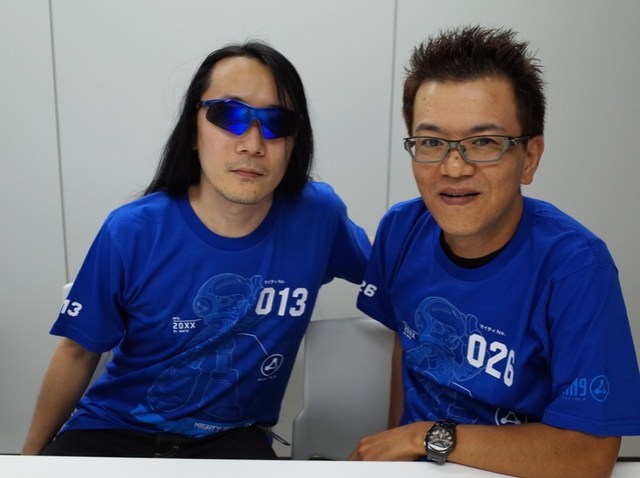
Whilst his most recent venture may not have received universal praise, Takashi Tateishi (pictured right) has undoubtedly left his mark on gaming’s musical legacy with the timeless tunes of Mega Man 2. In a personal interview that took place back in 2015, Brave Wave’s Mohammed Taher delves into the stories and history behind not only one of the most iconic game soundtracks of all time, but the life and career of the person who created it. For fans of both the Mega Man series as well as game music in general, it’ll serve as an informative read that sheds some light on elements of the creative process that are radically different to those of today.
Now for something very niche, but also very interesting (that’s kind of what we do here). Our friends at SourceGaming conducted an interview with Amir Latif, a programmer who worked on Nintendo 64DD art software that would eventually become Mario Artist: Paint Studio, a Japan-only successor to Mario Paint that made use of a number of unique capabilities offered by the 64DD expansion. This is a particularly noteworthy discussion, as it offers a behind the scenes look at the undiscovered title, including ideas and content that didn’t make it into the final product, as well as details about the unreleased Sound Maker entry to the series. Many questions surrounding the 64DD’s development remain unanswered, and efforts for preservation of the unique addon and its library are still on-going – with this in mind, it’s great to see some information revealed about a game that could easily have been lost to time without the interest of a small but dedicated fan-base.
Toco Toco reaches the last of its game creator-themed specials, this time focusing on Keiichiro Toyama, former Konami and long-time Sony employee who has worked on the likes of Silent Hill, Forbidden Siren and most recently, the Gravity Rush series. The video follows Toyama on his daily commute through Yokohama’s Hodogaya ward, giving us a glimpse into the SIE Japan Studio offices before introducing us to his co-workers and their shared approach to developing games.
Toyama discusses the sense of freedom he wishes to convey in his games, something which is evident in the free-flying mechanics of the Gravity Rush series. As with the previousvideos in the series, it’s interesting to learn how the experiences and surroundings have influenced the creators behind beloved franchises, and how aspects of their personal lives shine through in what they create.
As usual, be sure to check out more of Toco Toco’s Japanese creator videos on their YouTube channel, and keep an eye on their Twitter feed for updates and exclusive giveaways.
ASH: Archaic Sealed Heat
Developer(s): Mistwalker, Racjin
Publisher: Nintendo Platform(s): DS Release Date: October 4th 2007 (Japan exclusive)
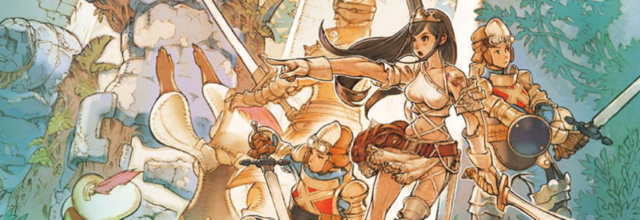
Despite the relatively unchanging formulas that run throughout the genre, turn-based, grid-based strategy games have consistently managed to retain their popularity across every generation. With newcomers such as The Banner Saga joining long running series such as Civilization and Fire Emblem in leading the charge, it’s easy to find a game suitable for scratching your strategic itch on almost any platform. The DS in particular played host to a wide and diverse range of RPGs of every type, with Japanese-made titles in particular thriving in the console’s heyday. ASH: Archaic Sealed Heat fits nicely into the varied roleplaying lineup the system had to offer – it may not be quite as polished as its better-known DS strategy counterparts, but this Japan-exclusive release has a lot to offer for those looking for something original, in more ways than one.
Released exclusively in Japan in 2007, ASH was one of many titles developed by the then-new Mistwalker, a development studio founded by Final Fantasy creator Hironobu Sakaguchi. Following his departure from Square-Enix, Sakaguchi has remained involved in the JRPG scene, with the likes of Lost Odyssey, Blue Dragon and The Last Story being met with varying levels of commercial and critical success. However, despite collaborating on development with the experienced Racjin, as well as Nintendo taking up publishing duties, ASH failed to garner widespread attention.
At face value, the game’s setting is that of a relatively simple fantasy story. Shortly after becoming Queen, heroine Aisha (sometimes translated as Aisya) finds her kingdom on the receiving end of an attack by an evil demon, with the vast majority of its populace unable to stand up to its ferocious power. However, Aisha soon discovers she wields the remarkable power to return some of her fallen allies to life using their ashes (hence the origin of the game’s unique title). From here, a fairly standard adventure begins – a ragtag group of heroes come together to push back the darkness and save the world. While the scenario itself fails to offer anything particularly fresh, well-written and amusing interactions between a likeable cast of characters help to supplement the plot.
What happens when you cross the gentle country lifestyle championed by Sylvanian Families, the internationally popular line of anthropomorphic animal mini-figures, with the hard-boiled, gripping criminal underworld that plays host to SEGA’s Yakuza series of crime games? Twitter user @momomousoumomo calls it ‘Yakuzania’ and their take on the seedier residents of Kamurocho in a more… cuddly style is certainly a spectacle to behold.
I’ll be frank – I haven’t a clue what the inspiration behind this bizarre mashup could be. Maybe we’re looking at a hardcore Yakuza fan who simply wants the series’s distinctive cast to get some much-needed downtime? Alternatively, perhaps they felt the grandiose 50’s-inspired setting of Sylvanian Families lacked a notable presence of organised crime. Either way, these are two franchises that make an unlikely duo, yet the universe of Yakuzania is a strangely compelling one…
First, let’s take a look at the characters. Series protagonist Kazuma Kiryu‘s sharp facial features and unmistakable white suit and red shirt (which according to actual Yakuza, doesn’t make for a particularly good fashion statement in the real-life criminal underworld) have been captured brilliantly – it appears that the majority of the cast are sporting handmade garments and facial hair pieces, and just looking at the amount of detail put in makes it apparent that they were made by someone who takes their Yakuza seriously. It’s a nice touch that Yakuza‘s resident violent eyepatch-wearer Goro Majima has been created both in his trademark garb as well as his cabaret girl disguise, which he uses in an attempt to ambush Kiryu in remake of the original game Yakuza: Kiwami.
The Hobonichi Techo daily planner, a brainchild of Japanese copywriter, TV personality and creator of the MOTHER series Shigesato Itoi and his company Hobo Nikkan Itoi Shinbun (Hobonichi), is back with a brand new lineup of stationary and accessories for 2017, including a selection that will most definitely be highly desirable to that crossover of MOTHER fans and regular Techo users.
Following successful launches of MOTHER-themed designs over the last few years, Hobonichi are introducing three new styles of of planner covers inspired by the cult favourite RPG series. First up is ‘Memories‘, which focuses on some of the weird and wonderful locations the game’s four heroes venture to on their journey. As the Hobonichi website aptly puts it, “the sight of all these nostalgic places is sure to bring back lots of memories”, staying true to the cover’s name.
Next up is ‘1994‘, which displays a motif inspired by the Super Famicom version of the game’s box art. Itoi states the packaging design was inspired by Japanese chocolate bar wrapping, which shows through in its bold gold and silver logo on a strong red backing. This is a great way to show your appreciation for an iconic design missed out on by the west.
The final design, simply named ‘Ness‘, comes in the form of a hardcover book released under the ‘Weeks’ range of weekly planners (as opposed to the Techo’s daily format). It feature’s MOTHER 2‘s protagonist in a variety of poses, printed on shiny blue necktie material. The sharp-eyed EarthBound fan might notice that some of the poses featured are actually exclusive to the Japanese version of the game.
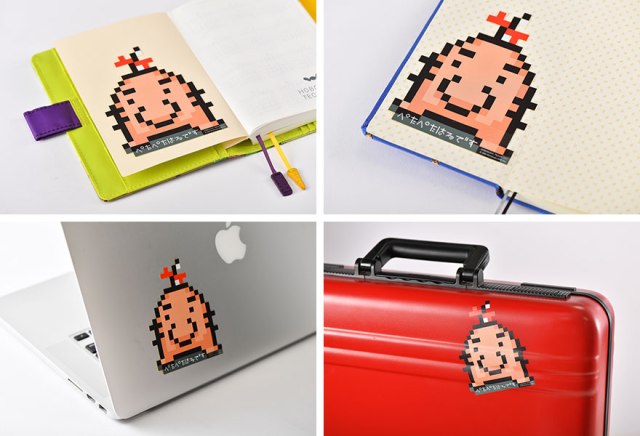
The latest version of Hobonichi’s Techo planner, as well as the wide range of covers and accessories available for it, are set to go on sale starting September 1st. Every order of a MOTHER Techo cover or Weeks planner contains a free large-scale Mr. Saturn sticker as an added bonus – in previous years, the MOTHER-themed covers have been some of the first to sell out, so keep a close eye on the Hobonichi Techo English website, where you can check out the full lineup of accessories.




















 Minus World
